In automotive manufacturing and precision component production, checking fixtures play an essential role in quality control. They are widely used for dimensional inspection, assembly verification, and production process monitoring. A high-quality checking fixture not only improves inspection efficiency but also helps manufacturers reduce production errors and ensure that products meet customer requirements and industry standards.
Especially for automotive stamping parts, sheet metal components, and welded assemblies, the design quality of a checking fixture directly affects the final product quality. Therefore, several critical factors must be carefully considered during the fixture development process.
1. Clearly Define Inspection Requirements and Fixture Functions
The first step in checking fixture design is to clearly identify the inspection objectives. Different components have different inspection requirements.
For example:
-
Automotive exterior panels require inspection of surface profiles, gaps, and flushness;
-
Structural components require accurate verification of hole positions, mounting locations, and dimensions;
-
Welded assemblies require validation of the assembly relationship between multiple components.
An excellent checking fixture design should be developed according to the characteristics of the product and inspection standards, ensuring that the fixture accurately represents the actual condition of the part rather than only measuring basic dimensions.
2. Ensure Accurate Datum Design and Positioning
Datum design is the core factor controlling checking fixture accuracy.
In the automotive industry, checking fixtures usually use product design datums as positioning references, including:
-
Locating holes;
-
Locating surfaces;
-
Supporting points;
-
Clamping positions.
Proper datum selection can minimize inspection errors and improve measurement repeatability. If the datum structure is not designed correctly, even a highly accurate fixture may produce unreliable inspection results.
Therefore, during the checking fixture design process, engineers must fully understand product GD&T (Geometric Dimensioning and Tolerancing) requirements and optimize the fixture structure according to actual manufacturing and assembly conditions.
3. Focus on Checking Fixture Manufacturing Accuracy
A checking fixture is not simply an auxiliary tool; it is a precision inspection system.
During the design stage, engineers need to consider:
-
Fixture base rigidity;
-
Part positioning accuracy;
-
Accuracy of checking pins and inspection blocks;
-
Manufacturing tolerances;
-
Potential deformation during long-term use.
For large automotive panel checking fixtures, insufficient structural strength may cause deformation after repeated usage, affecting inspection results. Therefore, selecting suitable materials and optimizing structural reinforcement are essential.
4. Consider Operation Convenience and Production Efficiency
A good checking fixture should not only provide high accuracy but also be easy for operators to use.
The design should consider:
-
Easy loading and unloading of parts;
-
Reasonable operation space;
-
Fast and reliable clamping mechanisms;
-
Simple and visual inspection procedures.
In automotive mass production, checking fixtures may be used hundreds of times every day. Complicated operations can reduce production efficiency and increase labor costs.
Therefore, modern checking fixture design places increasing emphasis on ergonomic design to improve operator experience.
5. Apply Digital Technologies to Improve Design Quality
With the continuous development of automotive manufacturing technology, traditional 2D fixture design is gradually being replaced by 3D digital design methods.
Advanced checking fixture development usually adopts:
-
CATIA, UG, and other 3D design software;
-
Digital simulation and analysis;
-
3D scanning inspection;
-
Digital comparison technology.
Through digital design methods, potential design problems can be identified earlier, improving accuracy and reducing fixture development time.
6. Consider the Actual Working Environment
Checking fixtures are normally used in production workshops where they are exposed to long-term operation, impacts, dust, and temperature variations.
Therefore, fixture design should consider:
-
Material durability;
-
Rust prevention treatment;
-
Maintenance convenience;
-
Replacement methods for fixture components.
A well-designed structure can extend fixture service life and reduce long-term maintenance costs.
7. Ensure Compliance with Customer Standards
Automotive customers usually have strict quality requirements, including:
-
OEM inspection specifications;
-
Product engineering requirements;
-
Checking fixture acceptance standards;
-
Measurement and inspection reports.
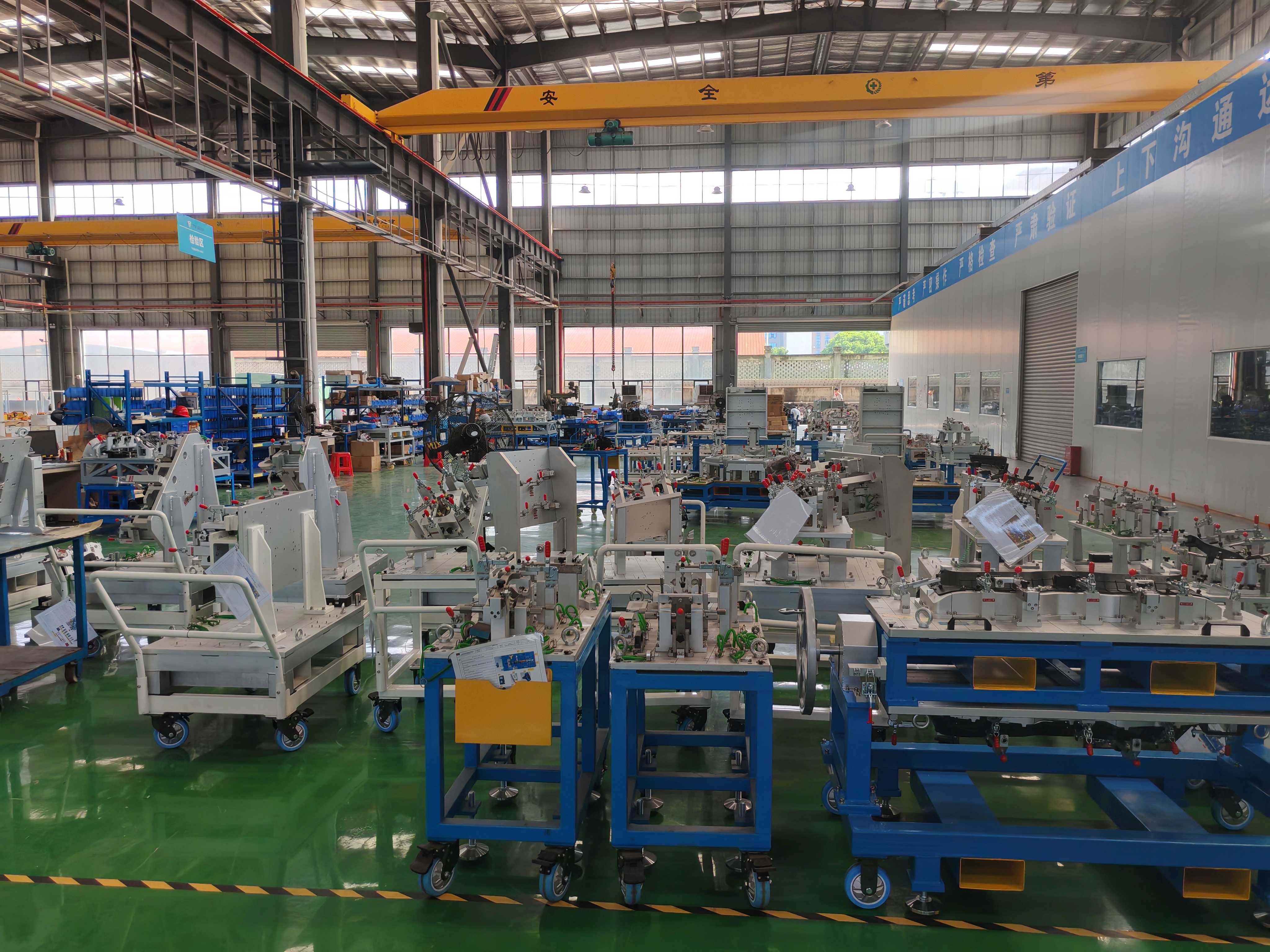
Checking fixture suppliers should communicate closely with customers during the early design stage to ensure that the fixture solution meets customer expectations and avoids repeated modifications later.
Conclusion
Checking fixture design is a comprehensive engineering process that combines product engineering, manufacturing processes, and quality control technology. An excellent automotive checking fixture design solution must not only meet inspection accuracy requirements but also consider manufacturing cost, operational efficiency, and long-term stability.
As a professional automotive checking fixture manufacturer, companies need to establish a complete quality control system covering product analysis, fixture design, manufacturing, and final acceptance. By providing high-precision and reliable inspection solutions, manufacturers can help automotive suppliers improve production efficiency, reduce quality risks, and achieve more stable smart manufacturing.