As automotive manufacturing continues to move toward lightweight structures, complex body designs, and higher dimensional accuracy, manufacturers are looking for inspection solutions that are not only precise but also easier to handle and maintain. A Carbon Fiber Inspection Fixture provides an effective solution by combining lightweight construction, high rigidity, dimensional stability, and flexible inspection capabilities.
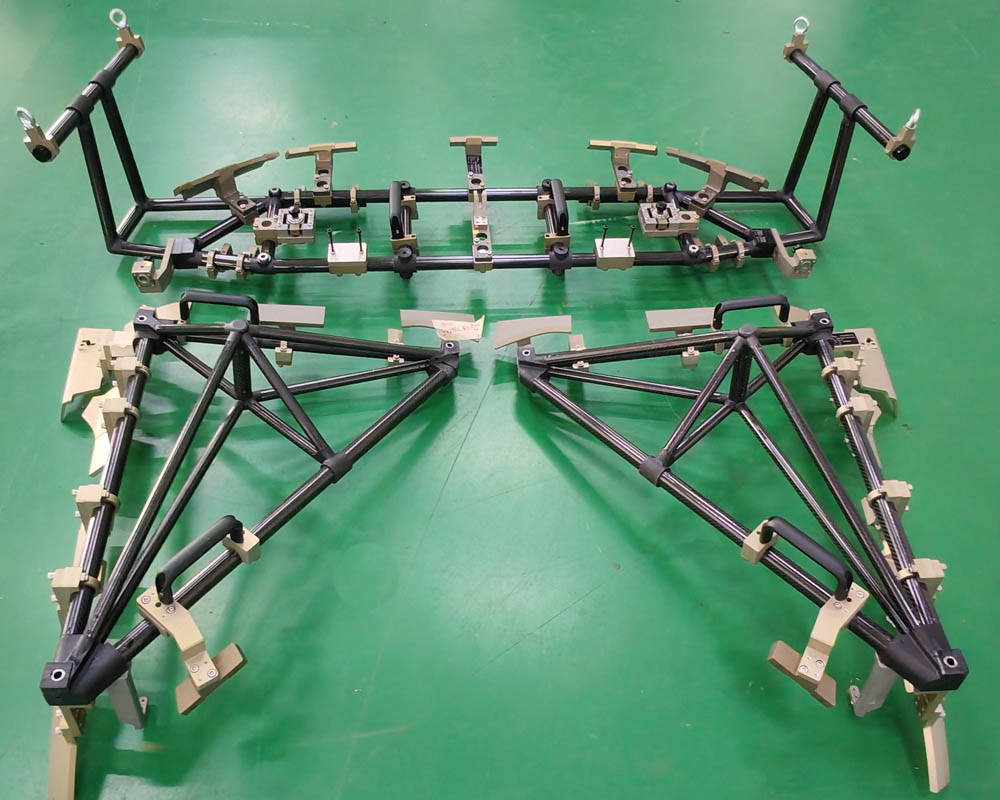
Compared with traditional steel inspection fixtures, carbon fiber structures can significantly reduce fixture weight while maintaining the rigidity required for accurate part positioning and measurement. This makes them particularly suitable for large automotive components and inspection applications where fixtures need to be frequently moved, installed, or adjusted.
What Is a Carbon Fiber Inspection Fixture?
A Carbon Fiber Inspection Fixture is an inspection tool manufactured primarily with carbon fiber composite materials and designed to accurately position and inspect automotive components. The fixture can incorporate locating pins, checking points, clamps, reference surfaces, measurement elements, and other inspection features according to the geometry and inspection requirements of the component.
In automotive manufacturing, a Carbon Fiber Checking Fixture can be used for body panels, interior components, exterior components, composite parts, and other complex-shaped automotive products. Depending on the application, the fixture can also be integrated with CMM measurement systems, optical inspection equipment, laser scanners, or other digital measurement technologies.
Lightweight Construction
One of the most important advantages of a Carbon Fiber Inspection Fixture is its lightweight structure. Large automotive inspection fixtures manufactured from conventional metal materials can become difficult to move and install, especially when inspecting large body components.
Carbon fiber offers a high strength-to-weight and stiffness-to-weight ratio. By reducing unnecessary structural weight, manufacturers can develop a Lightweight Inspection Fixture that is easier to transport, position, and operate.
This advantage is particularly valuable in production environments where inspection fixtures need to be moved between workstations or frequently repositioned during quality inspection.
High Rigidity and Dimensional Stability
Although lightweight, carbon fiber can provide excellent structural rigidity when the composite material and laminate structure are properly designed. A rigid fixture helps maintain stable reference points and reduces unwanted deformation during inspection.
Dimensional stability is also important for automotive inspection. Temperature changes can affect conventional materials and potentially influence measurement results. Carbon fiber composites generally have low thermal expansion characteristics, which can help maintain stable fixture geometry under controlled inspection conditions.
For this reason, a Carbon Fiber Automotive Inspection Fixture can be particularly useful for applications requiring repeatable positioning and consistent measurement.
Suitable for Large and Complex Automotive Components
Modern vehicles contain increasingly complex shapes and lightweight materials. Large body panels, roof components, floor panels, doors, interior parts, and composite components can require multiple locating and inspection points.
A Carbon Fiber Checking Fixture can be designed around the specific geometry of the component. Its structure can incorporate different locating systems, checking sections, measurement references, and support points to meet the requirements of different inspection processes.
For large components, the weight reduction offered by carbon fiber becomes especially valuable. The fixture can maintain a relatively rigid structure without becoming excessively heavy.
Improved Operator Efficiency
Inspection is not only about measurement accuracy. Fixture handling and operator efficiency are also important parts of the manufacturing process.
A lightweight Carbon Fiber Inspection Fixture can reduce the physical effort required when installing or repositioning the fixture. This can make inspection operations more convenient and help improve workflow efficiency.
For production lines with frequent inspection activities, easier fixture handling can also contribute to faster setup and reduced downtime.
Integration With Digital Inspection Technology
Modern automotive quality control increasingly combines physical fixtures with digital measurement systems. A Carbon Fiber Inspection Fixture can be designed to work with coordinate measuring machines, laser scanning systems, blue-light scanners, electronic measurement devices, and other inspection technologies.
The fixture provides stable locating references while digital equipment captures dimensional information from the component. This combination can help manufacturers establish a more efficient inspection process and obtain detailed dimensional data.
For applications involving complex surfaces, digital scanning combined with a lightweight carbon fiber fixture can provide an effective approach to automotive dimensional inspection.
Applications in Automotive Manufacturing
Carbon fiber inspection technology can be applied to a wide range of automotive components, including:
- Automotive body panels
- Doors and roof panels
- Floor and side-body components
- Interior trim components
- Exterior plastic components
- Carbon fiber and composite components
- Large automotive assemblies
- Battery-related vehicle components
- New energy vehicle body structures
The specific fixture structure depends on the component geometry, inspection requirements, production volume, and measurement method.
Why Choose a Carbon Fiber Inspection Fixture?
The key value of a Carbon Fiber Inspection Fixture is not simply that it is lighter than a conventional fixture. Its real advantage comes from combining lightweight construction with rigidity, dimensional stability, precision positioning, and compatibility with modern inspection technologies.
For automotive manufacturers and Tier 1 suppliers, these characteristics can make carbon fiber fixtures an attractive option for large or complex components where fixture weight, handling efficiency, and measurement stability are important considerations.
TTM GROUP develops automotive inspection solutions according to component geometry, inspection requirements, and production applications. By combining fixture engineering, precision manufacturing, and digital inspection technologies, a customized Carbon Fiber Inspection Fixture can be developed for different automotive quality-control requirements.
As automotive manufacturing continues to evolve toward lightweight structures and digital quality management, carbon fiber inspection technology provides a practical direction for developing lighter, more efficient, and highly stable automotive inspection fixtures.