In the automotive manufacturing industry,
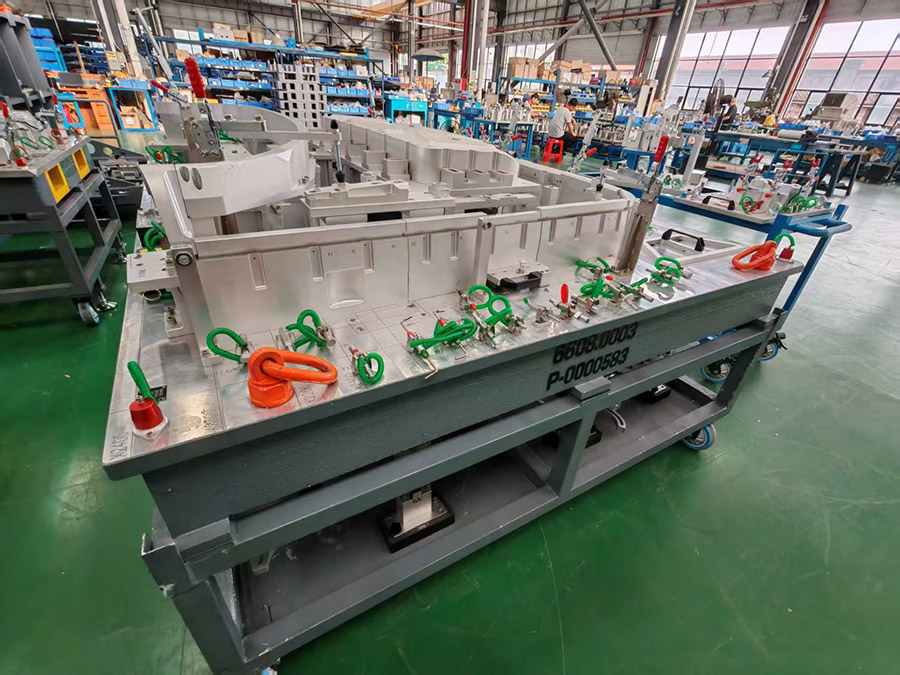
Checking fixtures are widely used for the quality control of automotive stamping parts, body panels, welded assemblies, plastic components, and interior & exterior trim parts, helping manufacturers maintain stable production and meet strict OEM quality standards.
Ensuring Dimensional Accuracy of Automotive Components
Automotive components often feature complex curved surfaces, precise mounting locations, and strict dimensional tolerances. Traditional measuring tools cannot efficiently perform comprehensive inspections on these parts.
A checking fixture simulates the actual vehicle assembly conditions by using locating pins, support blocks, checking gauges, inspection surfaces, and reference points to accurately position the component and verify critical dimensions.
Typical inspection items include:
-
Overall part profile accuracy;
-
Hole position and dimensional accuracy;
-
Gap and flushness requirements;
-
Critical assembly points and mounting locations.
For large automotive stamping components such as door inner panels, hood inner panels, side panels, and floor panels, checking fixtures provide a fast and reliable method to identify deformation, dimensional deviations, and forming issues.
Application in Automotive Stamping Parts Quality Control
Automotive stamping parts are essential structural components of vehicles, and their dimensional stability directly affects the final vehicle assembly quality.
During the stamping production process, checking fixtures are mainly used for:
First Article Inspection
After a new stamping die is developed, the first production sample is inspected using a checking fixture to:
-
Verify whether the die design meets requirements;
-
Confirm stamping forming results;
-
Identify issues such as springback, deformation, or insufficient forming.
Production Line Quality Inspection
During mass production, operators can quickly inspect parts using checking fixtures and detect potential quality problems caused by:
-
Die wear over time;
-
Material variation;
-
Changes in production parameters.
Compared with coordinate measuring machines (CMM), checking fixtures provide faster inspection and are more suitable for high-volume automotive production environments.
Application in Welded Assembly Inspection
Automotive body structures are usually assembled through multiple welding processes. After welding, components may experience thermal deformation, making accurate inspection essential.
Welding checking fixtures are designed to verify:
-
Overall dimensional accuracy of welded assemblies;
-
Position relationships between different components;
-
Welding deformation and hole alignment;
-
Assembly compatibility with vehicle structures.
Common applications include:
-
Front and rear structural assemblies;
-
Crash management systems;
-
Seat frame assemblies;
-
Instrument panel frames;
-
Battery tray structures.
By using welding checking fixtures, manufacturers can identify assembly risks early, reduce rework costs, and improve production efficiency.
Inspection of Automotive Plastic Components and Interior Parts
Checking fixtures are not limited to metal components. They are also widely applied in the inspection of automotive plastic parts and interior/exterior components.
Typical applications include:
-
Instrument panels;
-
Door trims;
-
Bumpers;
-
Center consoles;
-
Grille assemblies.
Plastic components can be affected by material shrinkage, temperature changes, and molding conditions. Checking fixtures help verify:
-
Surface matching accuracy;
-
Assembly gaps;
-
Clip positions;
-
Mounting hole locations.
This ensures excellent fit and finish between components and the vehicle body.
Supporting New Vehicle Development Projects
During the development of new vehicle models, checking fixtures are essential tools for product validation and engineering verification.
They help automotive manufacturers:
-
Verify product manufacturability;
-
Validate stamping and tooling performance;
-
Support engineering changes;
-
Confirm production readiness before mass manufacturing.
With shorter automotive development cycles, high-precision checking fixtures enable faster validation and help accelerate project launch.
Checking Fixtures vs. CMM Inspection
| Item | Checking Fixture | CMM Inspection |
|---|
| Inspection Speed | Fast | Relatively slow |
| Application | Mass production quality control | Precision analysis and development |
| Operation | Simple and efficient | Requires professional operation |
| Inspection Method | Quick comparison and verification | Detailed dimensional measurement |
| Main Usage Stage | Production phase | R&D and quality analysis |
In modern automotive manufacturing, both technologies work together:
-
CMM systems provide accurate measurement data during product development;
-
Checking fixtures enable fast and reliable inspection on production lines.
The Future Development of Digital Checking Fixtures
With the growth of smart manufacturing, traditional mechanical checking fixtures are evolving toward digital solutions.
Modern checking fixtures increasingly integrate:
-
Electronic measurement systems;
-
Automated inspection technology;
-
Laser scanning solutions;
-
Digital data collection;
-
Manufacturing execution system (MES) connectivity.
Digital checking fixtures improve inspection efficiency, enable real-time quality monitoring, and provide complete production traceability.
Conclusion
Checking fixtures are an essential quality control solution in automotive manufacturing. From stamping parts and welded assemblies to plastic components, they provide accurate positioning, efficient inspection, and reliable quality assurance throughout the production process.
For global automotive OEMs and Tier 1 suppliers, high-precision checking fixtures are not only inspection tools but also a key foundation for achieving high-quality, efficient, and intelligent automotive manufacturing.