In today’s rapidly evolving industrial landscape, traditional manual welding methods are being replaced by intelligent, automated systems. The welding industry is undergoing a major transformation—shifting from experience-based craftsmanship to data-driven precision manufacturing. At the center of this shift is the modern welding workstation, redefining productivity, quality, and consistency.
The Limitations of Traditional Manual Welding
For decades, welding has relied heavily on skilled operators. While experienced welders can achieve high-quality results, manual processes still face several inherent challenges:
-
Inconsistent welding quality due to human variability
-
Low production efficiency in large-scale manufacturing
-
High labor intensity leading to worker fatigue and turnover
-
Difficulty in achieving standardized production processes
As manufacturing demands continue to increase, these limitations have become critical bottlenecks for industrial growth.
The Rise of Intelligent Welding Workstations
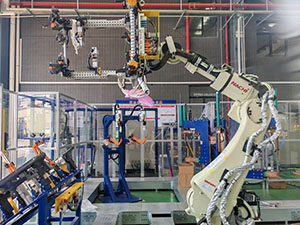
A new generation of smart welding workstations is transforming how industries approach metal joining and fabrication. By integrating automation, sensor technology, and intelligent control systems, welding has become more precise, stable, and efficient.
Key innovations include:
1. Automatic Parameter Optimization
Smart systems automatically adjust voltage, current, and welding speed based on material type and thickness, significantly reducing setup time and human error.
2. Real-Time Quality Monitoring
Integrated sensors continuously monitor the welding process, detecting defects such as porosity, incomplete fusion, or inconsistent seams in real time.
3. High Consistency and Repeatability
Unlike manual welding, intelligent systems ensure uniform quality across long production cycles, even under continuous operation.
4. Data-Driven Manufacturing
Every welding operation is recorded and analyzed, enabling traceability, process optimization, and predictive maintenance.
Efficiency Gains Across Industries
The adoption of intelligent welding workstations is delivering measurable improvements across multiple sectors, including automotive manufacturing, steel structure fabrication, machinery production, and heavy equipment assembly.
Typical benefits include:
-
30%–60% increase in production efficiency
-
Significant reduction in labor dependency
-
Lower defect and rework rates
-
Optimized overall manufacturing costs
These improvements directly translate into higher profitability and stronger competitiveness in global markets.
From Skilled Labor to Intelligent Systems
The traditional welding model depends heavily on “master-level” experience. In contrast, modern welding workstations rely on standardized digital processes and intelligent control algorithms.
This transformation enables:
-
Digitalization of welding expertise
-
Standardization of operating procedures
-
Visualization of quality control
-
Reduced reliance on highly specialized labor
As a result, manufacturers can scale production without being constrained by workforce limitations.
The Future: Fully Integrated Smart Welding Ecosystems
The next stage of development will integrate welding workstations into broader smart manufacturing ecosystems, powered by Industry 4.0 technologies such as AI, robotics, and industrial IoT.
Future trends include:
-
Fully automated robotic welding lines
-
Cloud-based process optimization
-
AI-driven predictive maintenance
-
Unmanned smart factories
Welding is no longer just a manual skill—it is becoming a core component of intelligent industrial systems.