Modern automotive components are becoming increasingly complex. Lightweight structures, high-strength materials, free-form surfaces, tighter dimensional tolerances, and more demanding assembly requirements are creating new challenges for manufacturers and engineering teams.
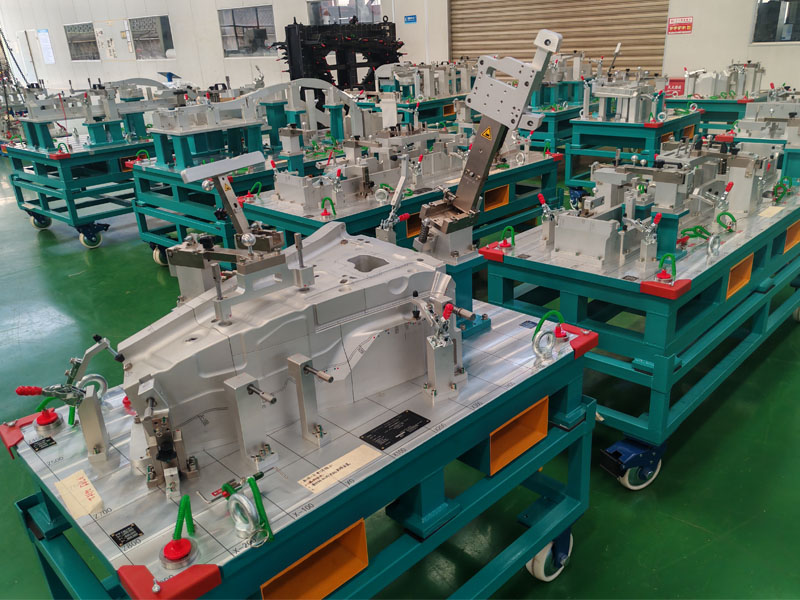
In this environment, fixture design for complex automotive parts plays an important role in maintaining dimensional accuracy and production consistency. A properly designed fixture can provide stable positioning, controlled support, accurate reference points, and convenient access to critical areas during inspection and assembly.
However, designing fixtures for complex automotive components is not simply a matter of creating a structure around a part. Engineers need to consider product geometry, datum systems, deformation, accessibility, manufacturing accuracy, material selection, operating efficiency, and final validation.
Here are 10 key challenges that should be considered when developing fixtures for complex automotive parts.
1. Establishing a Reliable Datum and Positioning System
One of the first challenges in fixture design for complex automotive parts is establishing a reliable datum system.
Simple components may have obvious reference holes, flat surfaces, or straight edges. Complex automotive parts can be very different. They may contain curved surfaces, irregular profiles, thin sections, and limited areas suitable for locating.
Engineers need to study the product's 3D CAD data and GD&T requirements before selecting primary, secondary, and auxiliary locating points.
A reliable positioning strategy should:
- Keep the component stable
- Provide repeatable positioning
- Minimize unnecessary deformation
- Reflect the intended assembly or measurement condition
- Leave important inspection areas accessible
If the datum strategy is incorrect, dimensional results may be affected throughout the entire inspection process.
For this reason, datum planning should be one of the earliest steps in complex automotive fixture development.
2. Managing Complex and Free-Form Surfaces
Modern automotive components often contain highly curved or free-form surfaces.
Examples include exterior body panels, fenders, pillars, wheelhouse components, structural parts, brackets, and other stamped components.
These geometries can make conventional positioning and measurement methods difficult to apply.
The fixture may need specially designed contour surfaces, profile references, support points, gap measurement features, flushness references, or section inspection elements.
For a complex body component, engineers may need to consider:
- Surface contour
- Edge profile
- Hole locations
- Gap dimensions
- Flushness
- Section profiles
- Assembly interfaces
The challenge is to reproduce the critical characteristics of the component accurately without making the fixture unnecessarily complicated.
3. Maintaining High Fixture Accuracy
A fixture is only as reliable as its critical reference and locating features.
During fixture design for complex automotive parts, engineers must consider how the design will ultimately be manufactured and assembled.
Locating pins, reference surfaces, support blocks, inspection points, and other critical elements must maintain the required tolerances.
The overall accuracy chain can be viewed as:
Product datum → fixture datum → locating accuracy → inspection feature accuracy → assembly accuracy → final validation
Even if the original design is correct, machining or assembly errors can affect the final result.
For high-precision automotive applications, CMM measurement can be used to compare the finished fixture against the original CAD data.
This makes dimensional validation an important part of the overall fixture development process.
4. Controlling Part Deformation
Many automotive components are manufactured from thin sheet metal or lightweight materials.
These parts can easily deform when subjected to clamping force or uneven support.
This creates a significant challenge in fixture design for complex automotive parts.
If too much clamping force is applied, the component may be forced into an artificial condition. If there is insufficient support, the component may move during inspection or assembly.
The fixture therefore needs to balance stability with deformation control.
Depending on the component, the design may incorporate:
- Locating pins
- Support blocks
- Adjustable supports
- Clamping devices
- Quick-release mechanisms
- Dedicated inspection points
For large components, the design should also consider the influence of the component's own weight.
The objective is to stabilize the part while maintaining a condition that accurately represents its intended manufacturing or assembly state.
5. Integrating Multiple Functional Requirements
Complex automotive components often require multiple functions from the same fixture.
A single fixture may need to support positioning, dimensional inspection, gap measurement, profile verification, hole checking, and assembly confirmation.
For example, a body component may require verification of:
- Mounting holes
- Outer boundaries
- Surface profiles
- Assembly interfaces
- Gap conditions
- Flushness
- Critical reference points
Integrating these functions requires careful planning.
If each feature is designed independently, interference between mechanisms may occur. Some inspection areas may also become difficult for operators to access.
Good complex automotive fixture design therefore considers the entire inspection and operating process rather than individual features separately.
6. Ensuring Operator Accessibility
A fixture may meet all technical requirements and still be inefficient if operators cannot use it comfortably.
Accessibility is therefore an important consideration in automotive fixture design challenges.
Engineers should consider how operators will:
- Load the component
- Locate the component
- Operate clamps
- Access inspection points
- Read measurement references
- Remove the finished part
Inspection points should be visible and accessible whenever possible.
For high-volume production, even a small improvement in loading or inspection time can have a significant impact on overall manufacturing efficiency.
A well-designed fixture should make the correct operating procedure simple and repeatable.
7. Converting 3D CAD Data Into a Physical Fixture
Modern automotive engineering relies heavily on digital product data.
However, converting a 3D model into a practical fixture is not simply a matter of reproducing the product's geometry.
Engineers need to interpret:
- Product datums
- Critical dimensions
- GD&T requirements
- Hole positions
- Surface profiles
- Assembly relationships
- Inspection requirements
These elements then need to be transformed into a physical design:
3D CAD data → datum strategy → locating concept → fixture structure → manufacturing → assembly → validation
This process requires knowledge of product engineering, mechanical design, GD&T, machining, and production requirements.
The final fixture must accurately represent the product while remaining practical to manufacture and operate.
8. Selecting the Right Materials and Structural Design
Material selection has a direct influence on fixture performance.
Steel offers high strength and rigidity, while aluminum can significantly reduce weight. Carbon fiber and other lightweight materials may also be appropriate for selected applications.
The choice depends on factors such as:
- Required rigidity
- Fixture size
- Weight limitations
- Thermal expansion
- Machining requirements
- Environmental conditions
- Expected service life
For large automotive fixtures, reducing unnecessary weight can make transportation and handling easier.
However, lightweight construction should never compromise dimensional stability.
Therefore, material selection needs to be considered together with the overall structural concept.
9. Balancing Precision, Cost, and Production Efficiency
One of the biggest automotive fixture design challenges is finding the right balance between precision, complexity, cost, and usability.
A fixture with excessive mechanisms may provide more functions but can also increase:
- Manufacturing cost
- Maintenance requirements
- Fixture weight
- Assembly time
- Operator workload
On the other hand, an overly simple fixture may not provide sufficient positioning or inspection capability.
For production applications, an effective workflow should allow:
Fast loading → accurate positioning → simple clamping → efficient inspection → quick unloading
Modular fixture elements can be useful when different inspection or positioning functions need to be integrated into one system.
10. Verifying the Finished Fixture
The final challenge is confirming that the manufactured fixture matches the original design requirements.
Before manufacturing, digital design reviews can identify potential interference, accessibility issues, locating problems, and structural conflicts.
After manufacturing and assembly, dimensional verification should be performed on critical fixture features.
CMM measurement can help verify:
- Reference points
- Locating pins
- Support locations
- Inspection surfaces
- Critical dimensions
- Fixture geometry
The measured results can then be compared with the original CAD data.
This final verification step helps identify machining and assembly deviations before the fixture is introduced into production.
TTM GROUP's Approach to Complex Automotive Fixture Design
TTM GROUP provides integrated manufacturing solutions covering automotive fixtures, welding fixtures, stamping dies, CNC machining, and automation equipment.
For complex automotive components, successful fixture development requires the integration of product engineering, fixture design, manufacturing technology, and dimensional verification.
From initial 3D CAD analysis and datum planning to precision machining, assembly, and final validation, each stage contributes to the performance of the finished fixture.
For body-in-white components, stamped sheet metal parts, high-strength automotive components, and complex structural parts, effective fixture design for complex automotive parts can help manufacturers improve positioning repeatability, reduce measurement variation, and support stable production.
By combining engineering experience with precision manufacturing and digital verification, fixture solutions can be developed according to the specific requirements of each automotive component.
Conclusion
The challenges involved in fixture design for complex automotive parts extend far beyond the physical shape of the component.
Datum selection, complex surfaces, part deformation, functional integration, operator accessibility, CAD data conversion, material selection, production efficiency, and final validation all have an influence on fixture performance.
As automotive manufacturing continues to move toward lightweight materials, high-strength structures, tighter tolerances, and increasingly digital production processes, fixture design is becoming more sophisticated as well.
For automotive manufacturers and Tier 1 suppliers, a well-engineered fixture can contribute to more consistent positioning, more reliable dimensional control, and greater production efficiency.
By combining accurate product data, appropriate datum planning, precision manufacturing, practical structural design, and final dimensional verification, manufacturers can develop fixture solutions capable of supporting the increasingly demanding requirements of modern automotive production.