As the electric vehicle (EV) industry continues to grow, automotive manufacturers are placing greater demands on quality inspection and dimensional verification. Among the many inspection tools used in production, the Battery Pack Checking Fixture has become an essential solution for ensuring the dimensional accuracy and assembly quality of EV battery packs.
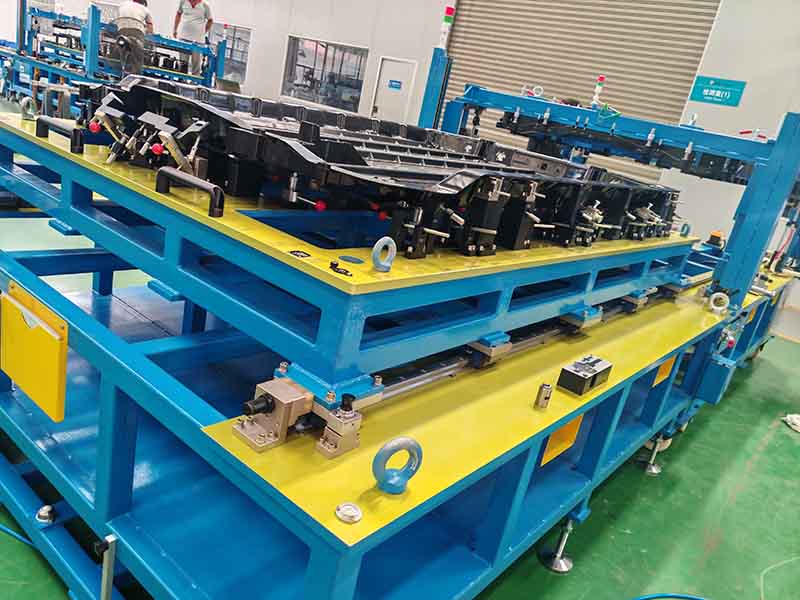
Although both traditional automotive checking fixtures and EV Battery Pack Checking Fixtures serve the purpose of dimensional inspection, they differ significantly in design philosophy, inspection targets, manufacturing precision, and production requirements. Understanding these differences helps manufacturers choose the right Checking Fixture for their applications while improving product quality and manufacturing efficiency.
What Is a Traditional Automotive Checking Fixture?
A traditional Automotive Checking Fixture is designed to inspect the dimensional accuracy of automotive components such as stamped parts, welded assemblies, body panels, chassis components, and interior or exterior trim parts.
Its primary functions include:
-
Verifying part dimensions against engineering drawings
-
Checking hole positions and locating features
-
Inspecting deformation after welding
-
Confirming assembly compatibility before production
Because automotive components vary greatly in size and function, traditional checking fixtures are typically designed for individual parts or subassemblies.
What Is an EV Battery Pack Checking Fixture?
A Battery Pack Checking Fixture, also known as a Battery Pack Inspection Fixture, is specifically developed for dimensional inspection during EV battery pack manufacturing.
Typical inspection targets include:
-
Battery Tray
-
Battery Housing
-
Battery Enclosure
-
Battery Pack Assembly
-
Cooling system mounting locations
-
High-voltage connector positions
-
Mounting holes and locating features
Compared with conventional automotive parts, EV battery packs are significantly larger and more complex, requiring higher levels of dimensional accuracy and structural stability throughout the inspection process.
1. Different Inspection Targets
The biggest difference lies in what each fixture is designed to inspect.
Traditional automotive checking fixtures are mainly used for:
-
Stamped metal parts
-
Welded components
-
Body panels
-
Small automotive assemblies
In contrast, a Battery Pack Checking Fixture is designed for:
-
Large aluminum battery structures
-
EV Battery Pack assemblies
-
Battery Trays
-
Battery Housings
-
Battery Enclosures
As EV manufacturers continue developing larger battery systems to increase driving range, battery pack dimensions are becoming increasingly complex. This requires larger inspection fixtures capable of maintaining exceptional measurement accuracy.
2. Higher Precision Requirements
The battery pack is one of the most valuable and critical components in an electric vehicle.
Even minor dimensional deviations may lead to:
-
Assembly difficulties
-
Poor sealing performance
-
Cooling system installation issues
-
Increased vehicle noise, vibration, and harshness (NVH)
-
Costly rework during assembly
For this reason, Battery Pack Inspection Fixtures demand higher repeatability, positioning accuracy, and measurement consistency than traditional automotive checking fixtures.
To achieve this level of precision, manufacturers typically incorporate:
-
Precision locating pins
-
High-rigidity base structures
-
Precision-machined datum surfaces
-
Modular inspection units
These features help reduce measurement errors while ensuring reliable EV Battery Pack Inspection results.
3. More Complex Fixture Design
Traditional automotive checking fixtures are generally designed for relatively simple individual components.
A Battery Pack Checking Fixture, however, often needs to inspect dozens or even hundreds of critical dimensions, including:
-
Length
-
Width
-
Height
-
Flatness
-
Hole locations
-
Datum references
-
Mounting interfaces
-
Weld distortion
As a result, engineers must carefully consider:
-
Workpiece weight
-
Material handling methods
-
Operator accessibility
-
Inspection sequence
-
Ergonomic design
Many large battery pack fixtures also integrate rotating mechanisms, lifting platforms, and quick-lock systems to improve inspection efficiency while reducing operator fatigue.
4. More Demanding Material Selection
Traditional checking fixtures commonly use steel, aluminum, engineering plastics, or resin materials.
Because EV battery packs are considerably larger, Battery Pack Checking Fixtures require an optimized balance between structural rigidity and overall weight.
Typical materials include:
-
High-strength welded steel base frames
-
Aerospace-grade aluminum structures
-
Wear-resistant locating components
-
Replaceable inspection modules
Proper material selection ensures long-term dimensional stability while minimizing maintenance costs.
5. Greater Automation and Digital Integration
As EV production volumes continue to increase, manufacturers are rapidly adopting intelligent inspection technologies.
Compared with conventional checking fixtures, Digital Battery Pack Checking Fixtures are more easily integrated with:
-
Digital measurement systems
-
Electronic inspection modules
-
Laser sensors
-
Automatic data acquisition systems
-
SPC quality analysis
-
MES manufacturing execution systems
These intelligent inspection solutions allow manufacturers to automatically collect measurement data, improve traceability, and strengthen process quality control while minimizing human error.
6. Higher Manufacturing Cost and Longer Development Cycle
Due to their larger size, higher precision requirements, and more sophisticated structures, Battery Pack Checking Fixtures generally require greater investment than conventional automotive checking fixtures.
The overall cost depends on several factors, including:
-
Product dimensions
-
Number of inspection points
-
Required tolerance
-
Level of automation
-
Inspection method
-
Material selection
Although the initial investment may be higher, a high-quality Custom Battery Pack Checking Fixture can significantly reduce scrap, rework, and production downtime, resulting in lower overall manufacturing costs over the product lifecycle.
How to Choose the Right Battery Pack Checking Fixture
When selecting a Battery Pack Checking Fixture Manufacturer, companies should evaluate several important factors:
-
Can the fixture meet the required dimensional tolerances?
-
Is the locating system stable and repeatable?
-
Does it support fast model changeover?
-
Can it integrate digital inspection technologies?
-
Is maintenance and calibration convenient?
-
Does the supplier have extensive EV manufacturing experience?
For international projects, manufacturers should also ensure that the inspection fixture complies with customer standards and is supplied with complete inspection reports and quality documentation.